
How to Search Criminal Dockets
Start with the court that has the case now. Miami County Municipal Court takes countywide misdemeanors plus preliminary felony hearings. Felony cases go to the Miami County Court of Common Pleas, General Division. For both layers, the public entry point is the county's CourtView/eServices gateway. The landing page labels everything "case information." It lets you search by case number, case type, name, attorney, or ticket/citation number.
Expect an "I'm not a robot" browser check before the legacy search screen appears. That step is normal. Once past it, type the narrowest identifier printed on a court notice, because a name alone can pull up more than one person. Before trusting any result as the right Miami County criminal docket, match the court. Check the case number and the event dates too.
- Classify the matter as a Municipal Court misdemeanor or preliminary felony proceeding, or as a Common Pleas felony case.
- Open CourtView/eServices and complete the ordinary browser verification prompt without trying to bypass it.
- Search first with the exact case number or ticket/citation number. Use a name only when a narrower identifier is unavailable.
- Open the matching case information and read its court, dated entries, settings, and any visible disposition in sequence.
- Confirm a required appearance with the court and contact the clerk for a file-stamped or certified record when an official document is needed.
Miami County Criminal Docket CourtView Search
CourtView offers four public service paths: Case Search, Filing, Payments, and Calendar. The landing text lists several ways to narrow a Miami County criminal docket. The live form controls appear only after verification, though. Copy identifiers exactly. No published Miami County source sets a required name order, a wildcard rule, or one universal local case-number pattern. Reconstructing a number from memory invites errors.
| Portal pathway | Verified use | Practical limit |
|---|---|---|
| Case Search | Case number, type, name, attorney, or ticket/citation number | Live fields appear after browser verification. |
| Calendar | View court schedules and permitted bookings | Confirm a required appearance with the court. |
| Filing | Electronic filing access | Login or registration is required. |
| Payments | Case-level payment where the court makes it available | It is not a general criminal-case status tool. |
Note: CourtView's terms bar bulk downloading, direct parser bypasses, and data mining. Keep each lookup manual and tied to one case.
What a Criminal Docket Shows
Think of a Miami County criminal docket as a dated sequence, not a one-word verdict. Public case information can surface the case number and caption. It can also show the court or division, dated filings and orders, visible party or attorney details, settings, and an outcome when released. The Clerk's conditions state that CourtView holds selected public records. It may leave documents out. So treat every visible field as one piece of the timeline. A full display it is not.
| Case number | The court-assigned identifier. No universal Miami County criminal format was published, so use the number exactly as printed. |
|---|---|
| Charges or initiating event | A complaint, citation, indictment, or transfer entry may show how the matter began. |
| Settings | Dated appearances such as arraignment, preliminary hearing, pretrial, motion hearing, or trial setting when released. |
| Orders and filings | Chronological court actions and submitted items; a document image is not promised for each entry. |
| Disposition | A dated decision point such as a plea, dismissal, judgment, or sentence. Read the full entry before drawing a conclusion. |
Miami County Criminal Docket Code Caution
Miami County has posted no complete criminal code or abbreviation legend for CourtView. Short labels are useful hints, nothing more. Guessing a local rule from an abbreviation invites error. So read the dated description around the entry and weigh it against the court and the case stage. When the next action or result stays unclear, ask the clerk.
- Arraignment
- An initial criminal appearance at which a plea may be entered. A portal payment in lieu of a traffic arraignment is described by CourtView as a guilty plea and waiver of contest or trial.
- Setting
- A scheduled court event. It can move, so it is not a guarantee that a trial or hearing will occur at that time.
- Judgment entry
- The filed written record of a ruling or disposition. The Common Pleas Clerk is the local route for file-stamped copies.
- Continuance
- A court-authorized postponement of a scheduled hearing or trial.
Miami County Criminal Docket Display Limits
The online Miami County criminal docket is a convenience view. The county's portal terms say so plainly. The service may omit filed documents. It can go down during outages, and it is not the official record. The Clerk's offices hold the official papers on file. A missing image or a thin result proves nothing about whether a filing ever happened.
For official copies, turn to the clerk. The Common Pleas Clerk's criminal-record information names the office that files, dockets, indexes, and preserves General Division records. That Clerk route is the way to get a file-stamped judgment entry or another certified court-file copy. An administrative public-record request is not the path.
The Miami County Common Pleas Clerk page lays out its court-record categories. It also lists the services the office provides.
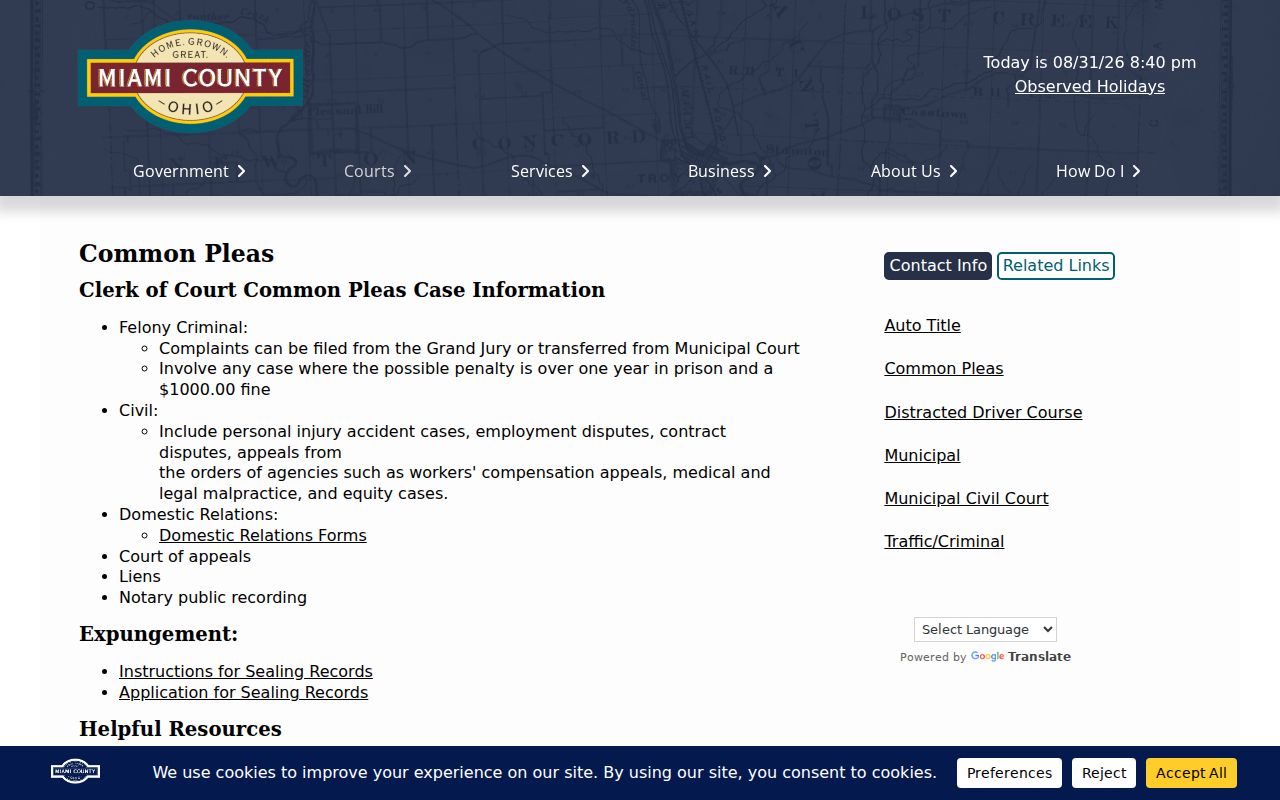
The clerk's own description draws the line clearly. A public result screen is one thing; the official Miami County criminal docket file the clerk holds is another.
Stages on a Criminal Docket
A criminal docket often opens with a complaint or citation, then moves through an initial appearance or arraignment, pretrial work, and a motion or hearing setting. From there it may show a plea, trial, dismissal, or judgment, with later entries covering sentence, costs, supervision, compliance, appeal, or other post-judgment events. The order varies case by case. Remember that a charge is not a finding. An older bond or release entry says nothing about current conditions.
Docket flow: Charge Filed › Arraignment › Pretrial Settings › Plea or Trial › Disposition › Sentencing
Source: the Municipal traffic and criminal clerk resource points to the local channel for municipal traffic and criminal matters.
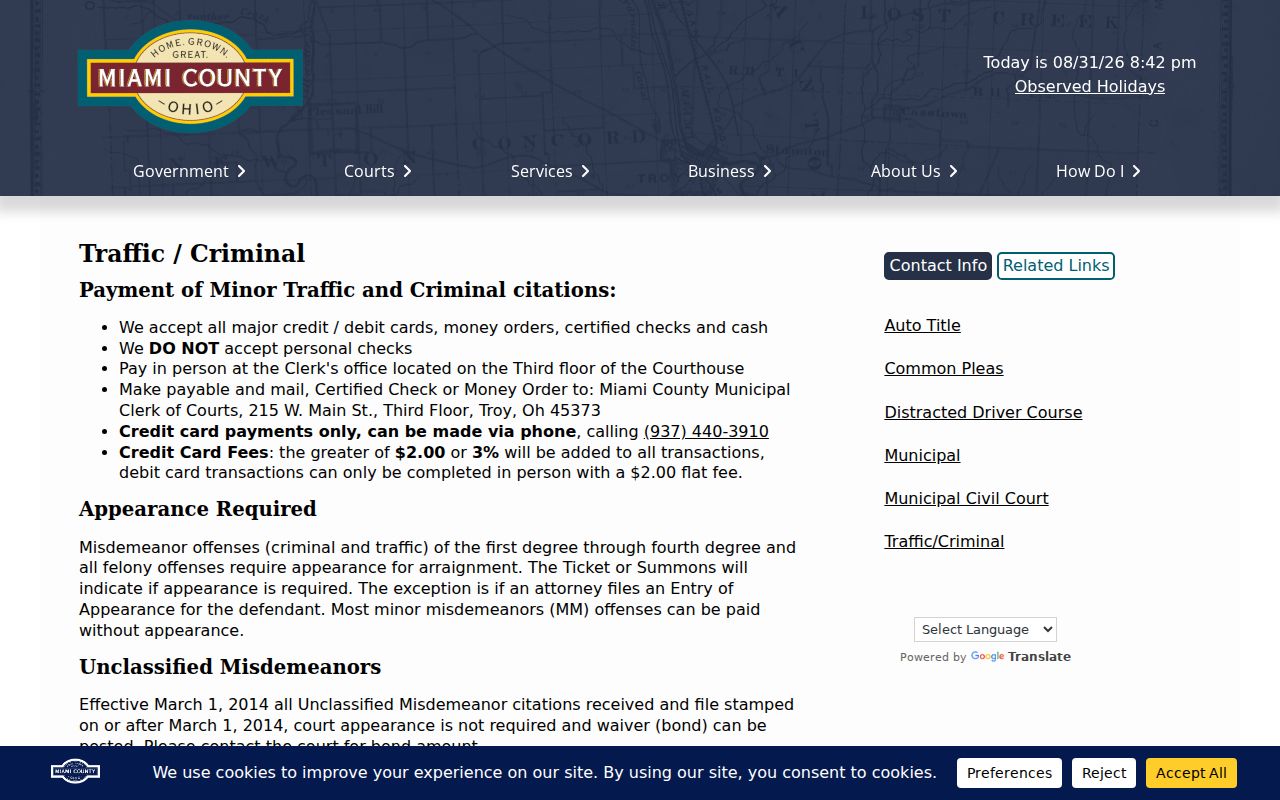
A payment option should never be assumed to apply to every criminal charge.
Miami County Criminal Docket Felony Handoff
A single Miami County criminal docket can pass through two courts. Municipal Court holds countywide jurisdiction over misdemeanors and preliminary felony hearings. A case may later move up. It can become a Common Pleas felony record in the General Division. Per the Common Pleas Clerk, felony complaints can originate with the grand jury. Some transfer over from Municipal Court. Watch for a handoff. Check any notice or entry for a court of origin. If it differs from the court holding the case now, search both layers.
Source: the Miami County Municipal Clerk directory separates the municipal divisions and their records channels.
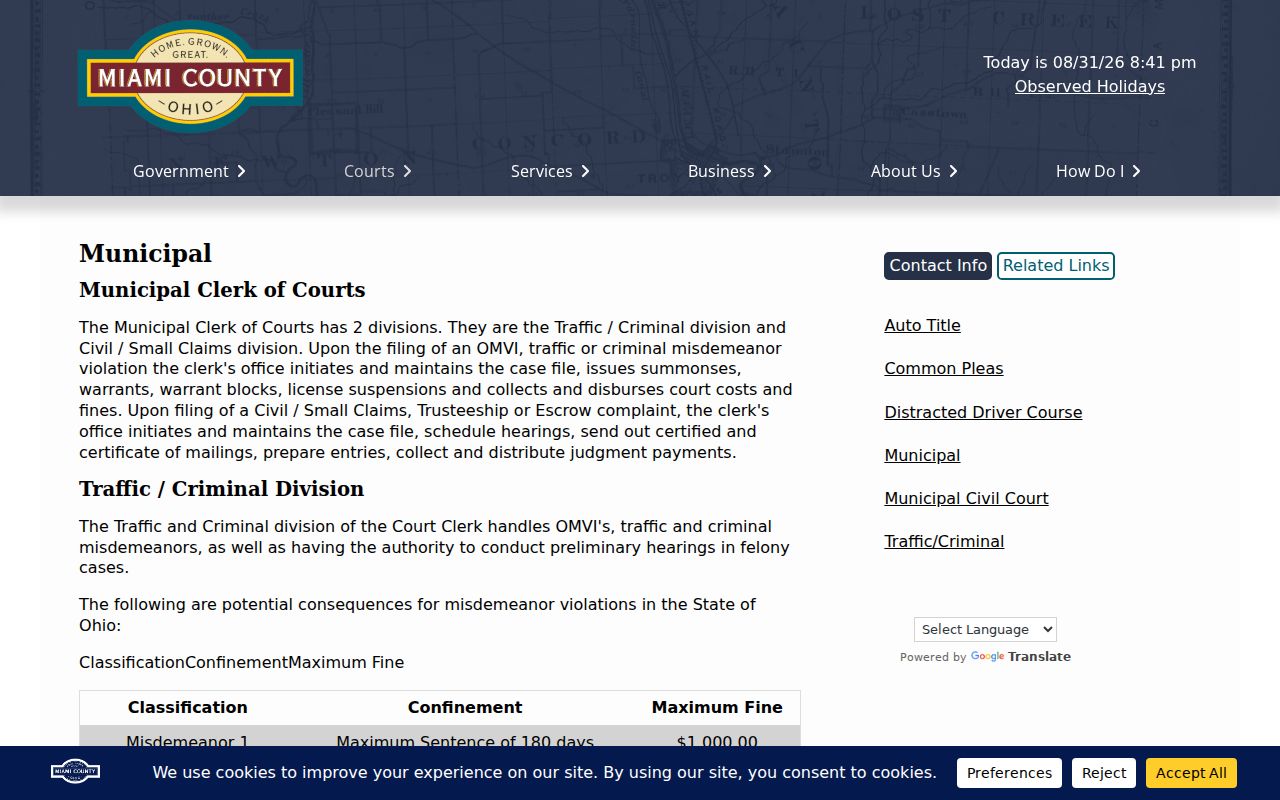
The Municipal Clerk source helps route an early misdemeanor or preliminary felony record correctly. That way it never gets mistaken for a final Common Pleas felony file.
Miami County Criminal Docket Specialty Programs
Two Miami County programs explain most specialty-court references you might spot on a criminal docket. One is Mental Health Court. The county describes it as possible term of community control. The other is Second Chance Drug Court. It is a certified drug-court program. Neither one shows up as a search filter. A routine docket entry will not tell you whether someone belongs to either. Eligibility turns on case-specific decisions the court makes. So treat public case information as background only, never as proof of program status. The official Miami County Mental Health Court page lays out the program's local context in the county's own words.
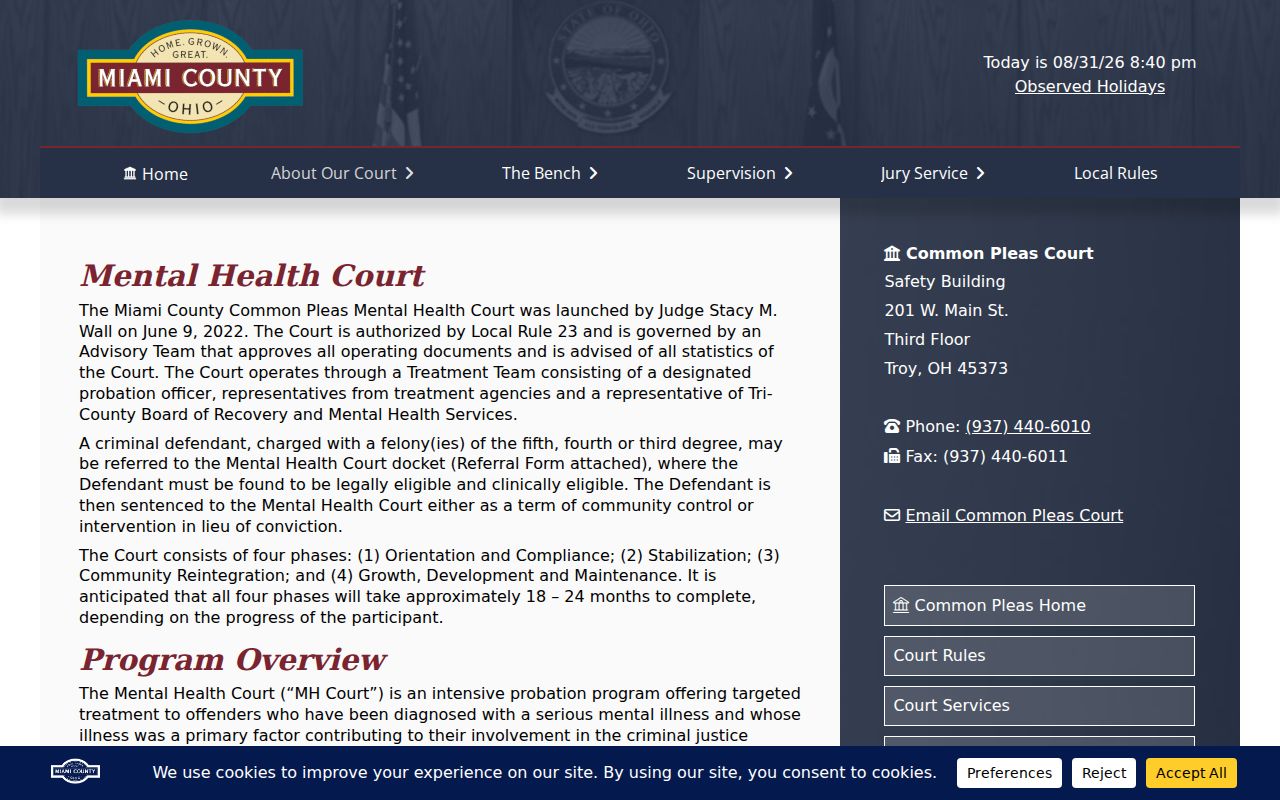
That page gives the setting a specialty-court label really means, without turning a public docket result into a clinical tag. For the county's certified drug-court program, the official Second Chance Drug Court page describes how it works.
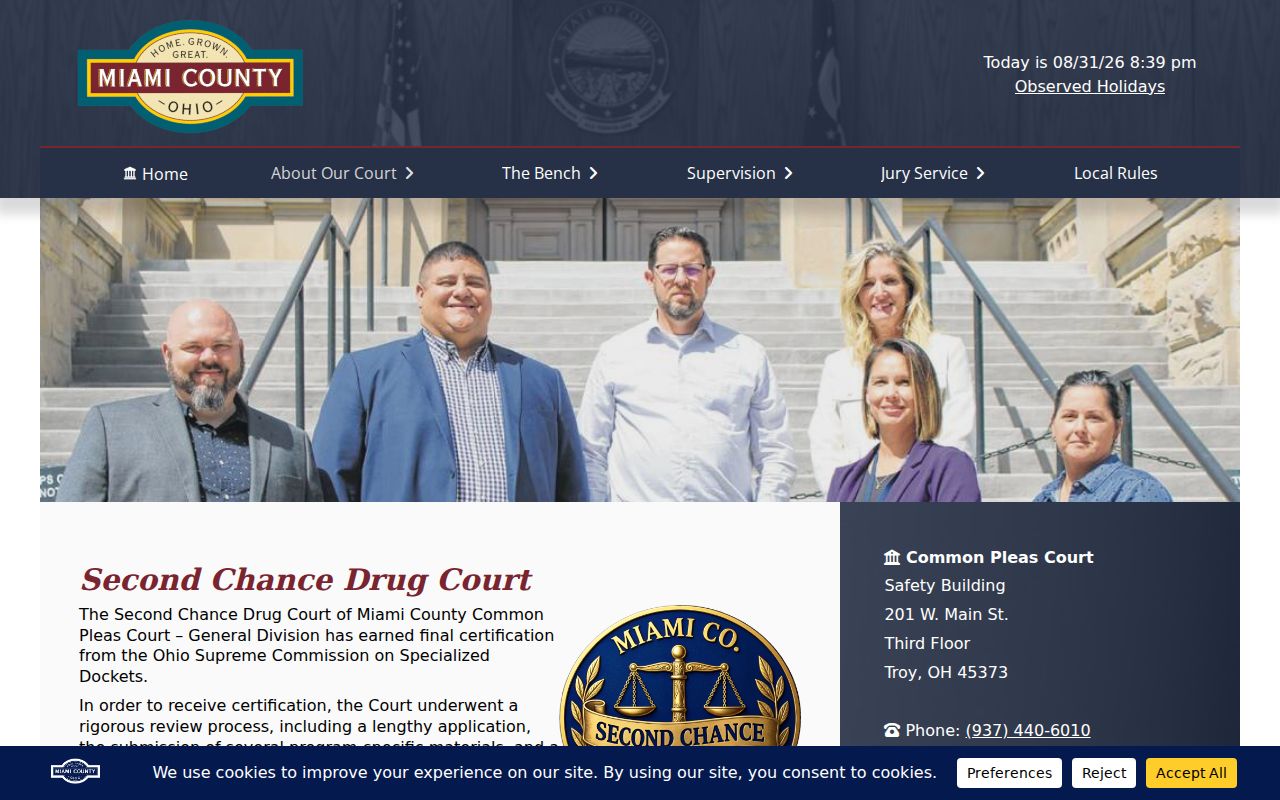
Its program description is helpful background. For dated case events, though, the individual Miami County criminal docket is still the record that counts.
Which Court Holds Criminal Dockets
Where does a criminal case actually live? For a misdemeanor, a local ordinance violation, a routine traffic-related criminal case, or a preliminary felony proceeding, Miami County Municipal Court is the likely start. A felony is different. It moves to the Miami County Court of Common Pleas, General Division once it is indicted or transferred. CourtView serves both courts. It is the first public search channel for each of them. But the clerk of the proper court keeps the official record. That office is the meaningful fallback whenever the online case information looks thin or incomplete.
| Record type | Miami County court route | Verification channel |
|---|---|---|
| Misdemeanor or preliminary felony | Municipal Court | Municipal traffic/criminal clerk and CourtView |
| Felony after transfer or indictment | Common Pleas, General Division | Common Pleas Clerk and CourtView |
| Juvenile matter | Juvenile Division | Juvenile Court’s authorized channel, not a general public search |
Miami County Criminal Docket Clerk Routes
Want copies or direct access? Go to the office that keeps the record. The Common Pleas Clerk sits on the third floor of the Safety Building at 201 W. Main Street, open weekdays 8 a.m. to 4 p.m. For Municipal traffic or criminal matters, visit the clerk on the third floor of the old courthouse at 215 W. Main Street. Posted weekday hours there run the same.
Common Pleas Clerk
Safety Building, third floor
201 W. Main St., Troy, OH 45373
(937) 440-6010
Municipal Traffic/Criminal Clerk
Old Courthouse, third floor
215 W. Main St., Troy, OH 45373
(937) 440-3910
Some Municipal records sit outside the County Clerk's hands. Under Municipal Court policy, the Court Administrator is custodian, and the public-record request form must be submitted in person.
Miami County Criminal Docket Calendar Checks
To check a Common Pleas or Municipal hearing date, start with the CourtView Calendar path after normal browser verification. Then call the relevant court whenever attendance matters. The portal itself says its calendar can view schedules and make permitted bookings. Live filters are another question. So confirm with the court before you rely on a single result. A past setting proves nothing about the next one. Outages and court closures can leave an old calendar entry stale. For a Municipal traffic or criminal question, the clerk's direct number is (937) 440-3910. For a Common Pleas criminal setting, call the Common Pleas Clerk at (937) 440-6010. Your citation is still the first source. It gives the initial response date and time. And when a court instruction conflicts with an older online calendar entry, the instruction controls.
Public Access and Sealed Criminal Dockets
Ohio presumes its court records open. Remote public access can be narrower, though. A Miami County criminal docket may count as public case information yet display none of the filed documents. When CourtView returns nothing, the gap could reflect selected online coverage, a remote-access limit, a restricted case category, or a sealing order. It does not establish that no case ever existed.
Key Rules:
Ohio Rules of Superintendence, Rule 45 presumes public access to court records while allowing courts to control remote access.
Ohio Rules of Superintendence, Rule 45(E) requires clear-and-convincing findings and the least restrictive means for access limits.
Ohio Revised Code 2953.32 provides the statutory application process for eligible adult sealing or expungement matters.
Ohio Revised Code 2151.356 addresses certain juvenile sealing and expungement questions.
Miami County Criminal Docket Missing Results
Start by identifying the division. Juvenile matters have no documented general public name-search route. Probate's public calendar excludes adoption and mental-illness matters. An adult criminal case can still be restricted remotely. It can show an omitted document even where direct access exists. Don't chase repeated name variants, technical workarounds, or unofficial copies to beat an access limit. Instead, hold onto the case number. Keep the court and the last dated event you could see. Then contact the right Miami County Clerk or court office for direct-access or copy instructions. Sealing, correction, or certification all run through the court's prescribed procedure. The public search route changes nothing about a record and establishes no legal result.